





The year 2025 marks a major shift in India’s distance-education ecosystem.
With the University Grants Commission (UGC) releasing updated regulations and approvals for ODL (Open & Distance Learning) and Online Programs, only a limited number of universities now meet the new performance, accreditation, and digital-learning standards.
On one hand, this brings higher quality and more reliable distance degrees for students.
On the other, it leaves a large learning population — especially school dropouts, working professionals, coaching centres, NGOs, and rural learners — searching for additional pathways to skills and employability.
This is where the Open and Distance Learning Council (ODLC) plays a meaningful and complementary role.
1. UGC’s 2025 ODL & Online Rules: What Changed?
The 2025 approval list made clear that only universities meeting strict benchmarks can offer degrees through:
- ODL Mode
- Online Mode
- Blended Formats
Factors like NAAC scores, NIRF ranks, and digital readiness have become mandatory.
But here’s the catch:
Universities are now highly regulated — leaving no space for micro-skills, short-term training, modular learning, or community-based education within the formal degree framework.
This gap needs a parallel skill ecosystem.
2. Why Formal Distance Degrees Alone Are Not Enough
Even with improved UGC oversight, distance education still faces challenges:
- Many students need job-ready skills, not only degrees
- Universities cannot run micro-certification programs the way flexible councils can
- Coaching centres lack a national-level credentialing body
- NGOs need ways to add employability programs without becoming universities
- Class 10/12 dropouts need non-formal pathways to learning
The demand for practical skill development + flexible learning is growing faster than traditional higher-education systems can respond.
That’s exactly the space ODLC strengthens.
3. Where ODLC Fits in the Post-2025 Education Landscape
ODLC is a national educational society registered under the Societies Registration Act, 1860, focused on empowering:
- Learners
- Tutors
- Training centres
- NGOs
- Skill practitioners
- Community learning hubs
ODLC does not act as a university and does not offer UGC-regulated degrees.
Instead, it complements the university system in three ways:
(A) Skill-Based Certificate Programs
ODLC offers certifications that focus on:
- Employability
- Micro-skills
- Vocational abilities
- Life skills
- Supportive academic competencies
These are essential for learners who:
- Already have a degree
- Are pursuing a degree
- Cannot enroll in a university
- Need short-term, affordable upskilling
(B) Centre Membership for Coaching & Skill Institutes
ODLC gives small institutions a way to:
- Add structured skill programs
- Access national-level methodologies
- Issue council-backed certificates
- Operate under an organized educational body
- Enhance credibility and student trust
For many coaching centres, ODLC becomes the “missing framework” they need to standardize their operations.
(C) National Membership for Individuals
Through ODLC membership, learners receive:
- A structured identity within a national education network
- Supportive certification options
- Access to flexible learning
- A sense of belonging to a recognized academic society
This is especially useful for:
- Jobseekers
- Freelancers
- Tutors
- Students needing extra support
- Individuals building a skill portfolio
4. ODLC Complements UGC — It Does Not Compete With It
After the 2025 changes, India’s education model looks like this:
UGC-Regulated Space
🎓 Formal Degrees
🎓 University-level Programs
🎓 Accredited ODL & Online Learning
ODLC’s Space
🟦 Non-formal Education
🟦 Skill Training
🟦 Micro-Credentials
🟦 Community Learning Support
🟦 Centre-Based Programs
🟦 Flexible Learning Pathways
Both systems operate legitimately but differently, serving different needs of the Indian learner.
Together, they create a holistic ecosystem:
👉 Degrees for Knowledge
👉 Skills for Employment
5. Why ODLC Matters Even More After UGC Tightened Norms
Because millions of Indians still need:
- Affordable upskilling
- Flexible learning options
- Informal-to-formal transition support
- Short-term vocational courses
- Community-level training
- Recognition for skills outside the university system
The new UGC norms strengthen the degree system.
ODLC strengthens the skill development and non-formal learning system.
Both are necessary for India’s workforce.
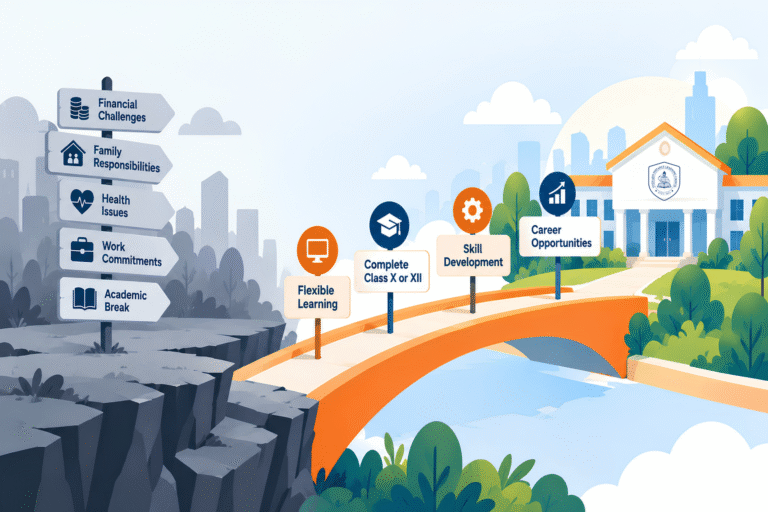
6. The Conclusion: ODLC Is the Bridge Between Education and Employability
UGC’s 2025 ODL and Online approvals mark a new era of quality in distance degrees.
But the ground reality remains:
✔ Not everyone needs a degree
✔ Not everyone can afford one
✔ Not all jobs require one
✔ Skills matter just as much
ODLC fills this gap by offering structured, ethical, non-formal learning opportunities that support:
- Students
- Working professionals
- Dropouts
- Trainers
- Coaching centres
- NGOs
- Community education leaders
In the new regulated environment, ODLC is not a replacement for UGC — it is a parallel platform that makes India’s education system more inclusive, flexible and employment-oriented.