




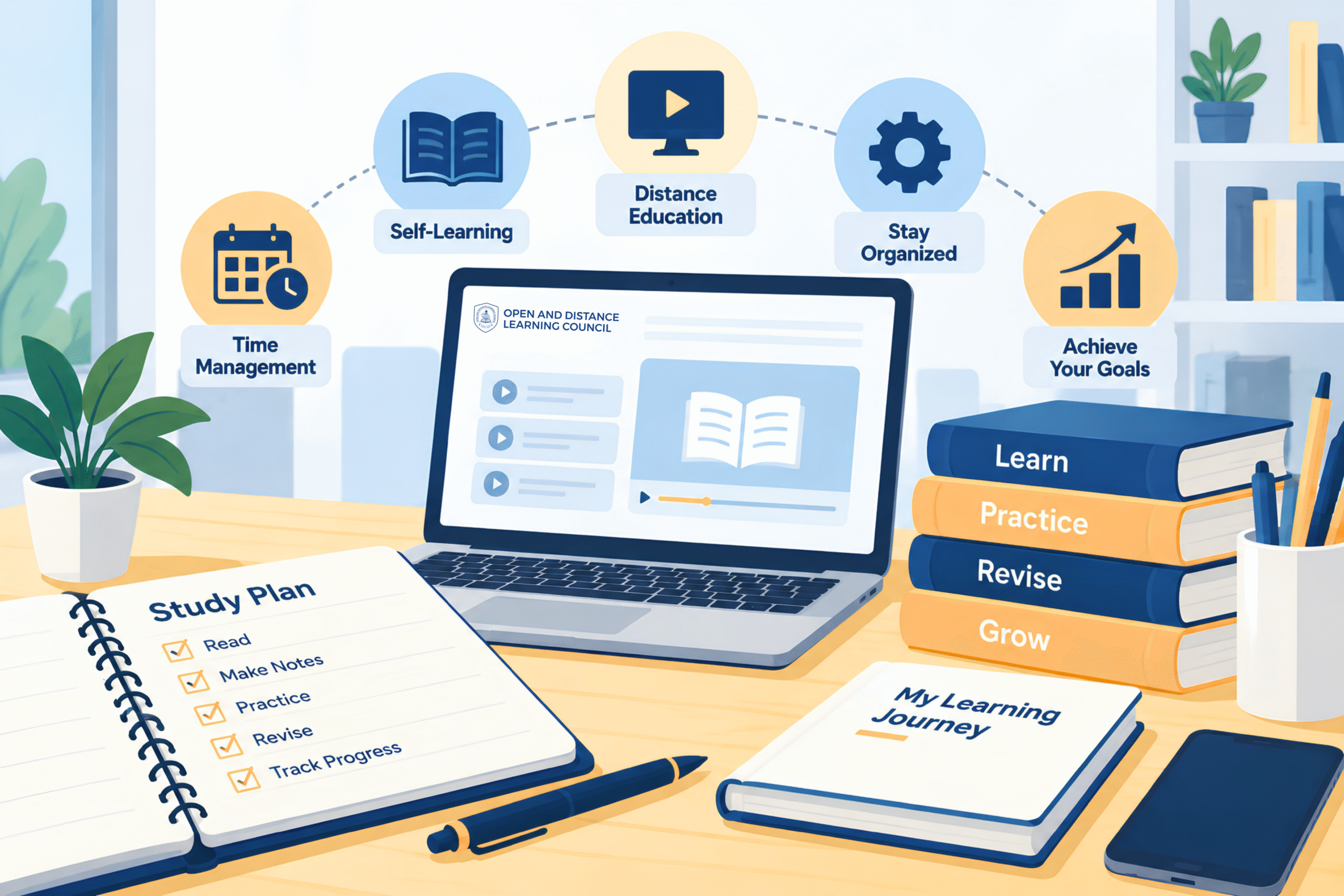
Self-Learning is an important part of distance education. Unlike traditional classroom learning, distance education gives learners more freedom to decide when, where, and how they study. Therefore, students need to take an active role in their education.
Distance education can be useful for students, working professionals, homemakers, and learners who want to continue their studies after a break. However, flexibility also requires planning and regular effort. With a simple Self-Learning routine, students can manage their studies in a more organized way.
ODLC supports open, distance, online, blended, and technology-enabled learning pathways. Its programmes are designed to provide flexible options for learners with different educational and personal needs.
What Is Self-Learning?
Self-Learning means learning independently instead of depending only on classroom teaching. A learner studies the provided materials, understands the topics, completes assignments, practices questions, and checks their progress.
In simple words, Self-Learning means taking responsibility for your own learning.
For example, a distance learner may:
- Read a study chapter.
- Watch an available learning video.
- Make short notes.
- Search for additional explanations.
- Practice questions.
- Complete assignments.
- Revise difficult topics.
- Prepare for assessments.
As a result, Self-Learning helps learners become more active and responsible in their education.
Why Is Self-Learning Important in Distance Education?
Distance education offers flexibility. However, students may not have daily classroom sessions. Therefore, they need to create their own learning routine.
Self-Learning helps students use this flexibility effectively.
1. It Gives You More Control
First, Self-Learning allows students to decide when to study. For example, a working learner can study after work, while another student may prefer morning study.
This makes learning easier to fit around daily responsibilities.
2. It Supports Different Learning Speeds
Every learner understands topics at a different speed. Some topics may be easy, while others may need more time.
With Self-Learning, students can spend extra time on difficult chapters. At the same time, they can move faster through topics they already understand.
3. It Builds Study Discipline
Distance education provides flexibility, but students still need consistency. Therefore, a regular Self-Learning habit can help learners stay connected with their studies.
Even a short study session every day can be more useful than studying only before an exam.
4. It Encourages Independent Thinking
Self-Learning encourages students to read, think, practice, and find solutions. As a result, learners become more confident in handling academic tasks.
How Does Self-Learning Work in Distance Education?
Self-Learning does not mean studying without any support. Instead, it means using the available learning resources independently while taking responsibility for your progress.
A simple process can look like this:
Study Material → Read → Understand → Make Notes → Practice → Revise → Check Progress
For example, a student studying a new subject can first read the chapter. Next, the student can write important points. Then, the student can answer practice questions. Finally, the student can revise the topic.
This simple process can make learning more organized.
How to Create a Self-Learning Routine
A good routine does not need to be complicated. In fact, a simple plan can be easier to follow.
Step 1: Set a Clear Learning Goal
Start with one clear goal.
For example:
“I will complete one chapter this week.”
A clear goal gives direction. Moreover, it makes progress easier to measure.
Step 2: Create a Daily Study Time
Next, choose a fixed time for study.
For example:
- Morning: 6:30 AM – 7:30 AM
- Evening: 7:30 PM – 8:30 PM
- Weekend: Longer revision sessions
However, the exact time depends on your daily routine.
The important point is consistency.
Step 3: Divide Large Topics Into Small Tasks
Large chapters can sometimes feel difficult. Therefore, break them into smaller parts.
Instead of writing:
“Complete the whole subject.”
Create smaller tasks:
- Read Chapter 1.
- Make notes.
- Learn key terms.
- Complete practice questions.
- Revise the chapter.
As a result, the learning process feels more manageable.
Step 4: Use Active Learning
Do not only read the material again and again.
Instead:
- Write short notes.
- Ask yourself questions.
- Explain the topic in your own words.
- Solve practice questions.
- Create simple examples.
- Revise important points.
This makes Self-Learning more active and engaging.
Step 5: Track Your Progress
Keep a simple study checklist.
For example:
| Task | Status |
|---|---|
| Chapter 1 Reading | Completed |
| Chapter 1 Notes | Completed |
| Practice Questions | Pending |
| Revision | Pending |
This small habit helps you see your progress clearly.
Self-Learning Tips for Distance Education Students
Here are some simple tips that can improve your Self-Learning routine.
Study at the Same Time
Try to study at a regular time each day. Over time, this can become a habit.
Keep Your Study Space Ready
Choose a clean and quiet place for study. Keep your books, notebook, laptop, and other required materials nearby.
Avoid Distractions
Mobile notifications, social media, and unnecessary browsing can reduce focus. Therefore, keep distractions away during study time.
Take Short Breaks
Studying continuously for many hours is not always effective. Instead, take short breaks between study sessions.
For example:
40 minutes study → 10 minutes break
You can adjust this based on your comfort.
Revise Regularly
Do not wait until the examination period to revise everything.
Instead, revise small sections every week. This makes exam preparation easier later.
How Self-Learning Helps Working Learners
Distance education can be useful for people who need to manage education along with work.
ODLC’s material on parallel skill education highlights flexible schedules, including evening, weekend, and self-paced study, as ways learners can continue education while working.
For example, a working learner can create a routine like:
Monday to Friday: 1 hour of Self-Learning
Saturday: 2 hours of revision
Sunday: Assignments and practice
This approach allows the learner to continue studying without making education the only responsibility.
Self-Learning and Flexible Education
One of the key benefits of distance education is flexibility. ODLC describes its learning pathways as open, distance, online, blended, and technology-enabled, depending on the programme.
Because of this flexibility, learners can build a study routine around their personal situation.
For instance:
- A working student can study after office hours.
- A homemaker can study during available free time.
- A learner returning after an education gap can study at a comfortable pace.
- An independent learner can spend more time on difficult subjects.
Therefore, Self-Learning can work well with flexible education.
How to Stay Motivated During Self-Learning
Motivation can change from day to day. Therefore, students should not depend only on motivation.
Instead, build simple habits.
Set Small Targets
Do not try to finish everything at once. Set small daily or weekly goals.
Celebrate Progress
Completing a chapter, assignment, or practice test is progress. Recognizing these small achievements can help you continue.
Remember Your Main Goal
Ask yourself:
Why am I studying?
Your answer could be:
- Completing Class X or XII.
- Continuing education after a break.
- Learning a new skill.
- Preparing for further education.
- Improving career opportunities.
- Developing professional knowledge.
A clear reason can help you stay focused.
Common Self-Learning Mistakes to Avoid
Self-Learning becomes easier when you know what to avoid.
1. Studying Only Before Exams
Last-minute study can create pressure. Instead, study regularly throughout the programme.
2. Making an Unrealistic Timetable
A timetable with too many hours may be difficult to follow. Therefore, create a plan that fits your actual routine.
3. Reading Without Practicing
Reading alone may not be enough. Use questions, assignments, examples, and revision to check your understanding.
4. Ignoring Difficult Topics
Do not keep postponing difficult chapters. Give them extra time or seek academic support when needed.
5. Losing Track of Assignments
Keep a record of assignments and other academic tasks. This helps prevent missed deadlines.
Self-Learning With ODLC
ODLC provides flexible learning pathways for learners who may not be able to follow a traditional classroom schedule. Its Secondary Level programme, for example, uses an open and distance learning model and is designed for learners such as school dropouts, working individuals, and independent learners. The programme information also highlights flexible study options and access to learning materials.
ODLC also supports vocational and skill-based learning pathways. This can help learners combine academic learning with skill development, depending on their chosen programme.
Therefore, Self-Learning can become an important part of an ODLC learner’s study routine.
A Simple Daily Self-Learning Plan
Here is an example of a simple routine:
| Time | Activity |
|---|---|
| 10 minutes | Review yesterday’s topic |
| 30 minutes | Learn a new topic |
| 10 minutes | Make short notes |
| 20 minutes | Practice questions |
| 10 minutes | Review key points |
You do not have to follow this exact schedule. Instead, adjust it according to your course and daily responsibilities.
The goal is to create a routine that you can follow consistently.
Self-Learning for Better Exam Preparation
Self-Learning can also support regular exam preparation.
ODLC’s distance-learning guidance recommends structured study plans, regular revision, syllabus awareness, and practice for distance learners.
Therefore, students can follow a simple approach:
Understand → Practice → Revise → Test → Improve
First, understand the topic. Then, practice questions. Next, revise the important points. After that, take a practice test. Finally, identify weak areas and study them again.
This creates a continuous learning cycle.
What If You Need Help?
Self-Learning does not mean that you must solve every problem alone.
If you do not understand a topic, use the academic support available through your programme. You can also review the study material again, ask questions, or seek appropriate academic guidance.
ODLC’s distance-learning information highlights learner support such as academic counselling, learning materials, assignments, and exam guidance across its programmes.
So, the best approach is a combination of independent learning and proper academic support.
A Simple Self-Learning Checklist
Before starting your study session, ask:
- What will I learn today?
- How much time do I have?
- Which topic should I complete?
- Do I need to revise yesterday’s lesson?
- Do I have any pending assignments?
- What did I understand today?
- Which topic needs more practice?
This simple checklist can keep your learning focused.
Final Thoughts
Self-Learning is one of the most important habits for successful distance education. It gives learners greater control over their study routine while encouraging discipline, consistency, and independent thinking.
However, Self-Learning does not mean studying without guidance. Instead, it means taking responsibility for your progress while using the study materials, academic support, and learning resources available to you.
With a clear goal, realistic timetable, regular practice, and consistent revision, distance education can become easier to manage.
For learners who need flexible education, ODLC provides open, distance, online, and blended learning pathways across academic and skill-based programmes.
Start small, study consistently, and keep moving forward. Your Self-Learning habit can become a strong part of your education journey.