




Introduction
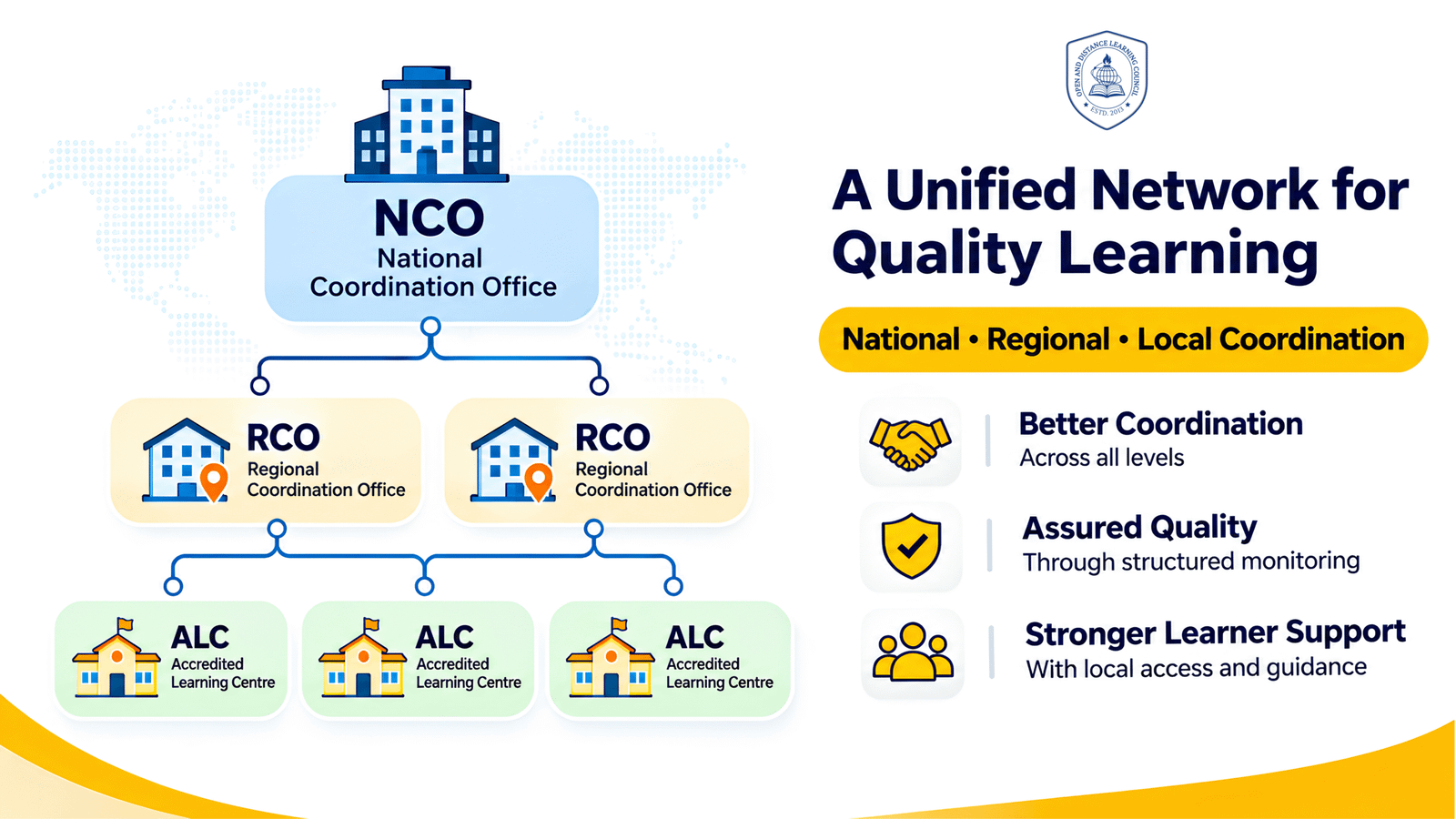
The ODLC’s NCO, RCO and ALC network is designed to support structured coordination, regional supervision, and learner-level academic facilitation. Each level has a defined role in the institutional framework of the Open and Distance Learning Council (ODLC).
As an institution’s network expands, clear responsibilities become important. Therefore, ODLC follows a multi-level structure that connects national coordination, regional oversight, and local learning support.
In this guide, we explain what NCOs, RCOs, and ALCs are, how they work together, and what institutions should understand before applying to join the network.
What Is ODLC’s NCO, RCO and ALC Network?
To understand the structure, it is helpful to look at the three key levels:
- National Coordination Office (NCO): Coordinates ODLC activities at the country level.
- Regional Coordination Office (RCO): Supervises learning centres within a defined region.
- Accredited Learning Centre (ALC): Supports learners and facilitates approved programmes at the institution level.
Together, these levels help organize institutional activities and maintain communication. At the same time, each office or centre must operate within its approved role and authorization.
1. National Coordination Office (NCO)
A National Coordination Office may be established in a country with approval from ODLC Global Headquarters (GHQ). Its main purpose is to coordinate academic, administrative, and compliance-related activities at the national level.
Key Responsibilities of an NCO
An approved NCO may:
- Coordinate academic, vocational, and skill-development activities across the country.
- Supervise and monitor Regional Coordination Offices.
- Review RCO documentation, infrastructure, and compliance.
- Submit consolidated reports to ODLC GHQ.
- Coordinate with educational institutions and relevant authorities, where applicable.
In addition, the NCO provides a national-level coordination point for regional operations. RCOs within the country report to the NCO, which remains accountable for their coordination and compliance matters.
2. Regional Coordination Office (RCO)
A Regional Coordination Office may be established by an approved NCO to support academic and skill-development activities within a specific region, state, or province.
While the NCO works at the country level, the RCO focuses on regional supervision and implementation.
Key Responsibilities of an RCO
An approved RCO may:
- Verify ALC and Skill/Training Centre documentation.
- Review infrastructure and trainer qualifications.
- Conduct physical inspections, where required.
- Monitor programme delivery, training quality, and learner support.
- Submit inspection and compliance reports to the NCO.
- Coordinate approved learning centres within its jurisdiction.
For example, an RCO may inspect an institution applying to become an ALC. It can review the centre’s facilities, documents, and training arrangements before reporting its findings through the appropriate ODLC process.
3. Accredited Learning Centre (ALC)
An Accredited Learning Centre is an institution-level centre that facilitates approved programmes and supports learners.
ALCs may include eligible schools, colleges, vocational institutes, skill-development centres, and other approved training institutions, depending on the applicable ODLC requirements.
Key Responsibilities of an ALC
An ALC may be responsible for:
- Facilitating learner registration and programme-related processes.
- Providing instruction, training, mentoring, and guided practice.
- Supporting learners during academic or skill-development activities.
- Maintaining accurate learner records and documentation.
- Verifying learner identity and eligibility documents.
- Supporting assessments and evaluations according to ODLC guidelines.
Moreover, ALCs help learners access local academic guidance and programme support. They are expected to follow the approved procedures and maintain accurate records.
How Do NCOs, RCOs and ALCs Work Together?
The ODLC’s NCO, RCO and ALC network follows a structured chain of coordination and accountability.
| Network Level | Main Role | Reports To |
|---|---|---|
| NCO | National coordination and compliance oversight | ODLC GHQ |
| RCO | Regional supervision and centre monitoring | NCO |
| ALC | Learner support and programme facilitation | RCO |
First, ALCs support learners and maintain centre-level records. Next, RCOs supervise centres within their regions and review their activities. Then, NCOs coordinate regional operations and compliance at the country level. Finally, ODLC GHQ provides overall policy direction and oversight.
In this way, each level has a defined responsibility rather than operating independently.
Why Is This Network Important?
A structured network can provide several benefits.
- First, clear responsibilities help institutions understand their roles and reporting channels.
- Additionally, RCOs provide regional coordination and supervision.
- At the learner level, ALCs help make programme guidance and support more accessible.
- Meanwhile, documentation reviews and inspections can support monitoring and accountability.
- Finally, common procedures help institutions follow applicable academic and administrative policies.
How Can an Institution Apply to Join ODLC’s Network?
Before applying to join the ODLC’s NCO, RCO and ALC network, institutions should identify the category that best matches their intended role.
For example, institutions seeking to facilitate approved programmes may explore the ALC pathway. Similarly, eligible organizations interested in regional coordination may consider the RCO pathway. Meanwhile, organizations seeking country-level coordination may explore the NCO pathway, where available.
However, joining the ODLC’s NCO, RCO and ALC network requires institutions to follow the applicable process. This may include document submission, eligibility review, verification, and compliance checks. Therefore, submitting an application does not automatically guarantee approval or authorization.
Important Points to Remember
Before applying, institutions should:
- Review the eligibility requirements for the selected category.
- Submit accurate institutional documents.
- Understand the responsibilities associated with the role.
- Follow the official application and verification process.
- Wait for written approval or authorization before representing themselves as an NCO, RCO, or ALC.
- Check the validity period and renewal conditions stated in the official authorization.
In addition, institutions should remember that membership or participation alone does not automatically authorize them to deliver programmes or represent ODLC. Such activities require the appropriate written authorization.
Conclusion
Overall, the ODLC’s NCO, RCO and ALC network provides a structured approach to institutional coordination, regional supervision, and learner-level facilitation.
In summary, the NCO supports country-level coordination, the RCO monitors regional activities, and the ALC provides local programme support. By defining these responsibilities, the network aims to support organized operations and consistent procedures.
Therefore, institutions interested in joining should review the applicable requirements carefully and follow ODLC’s official application process.