





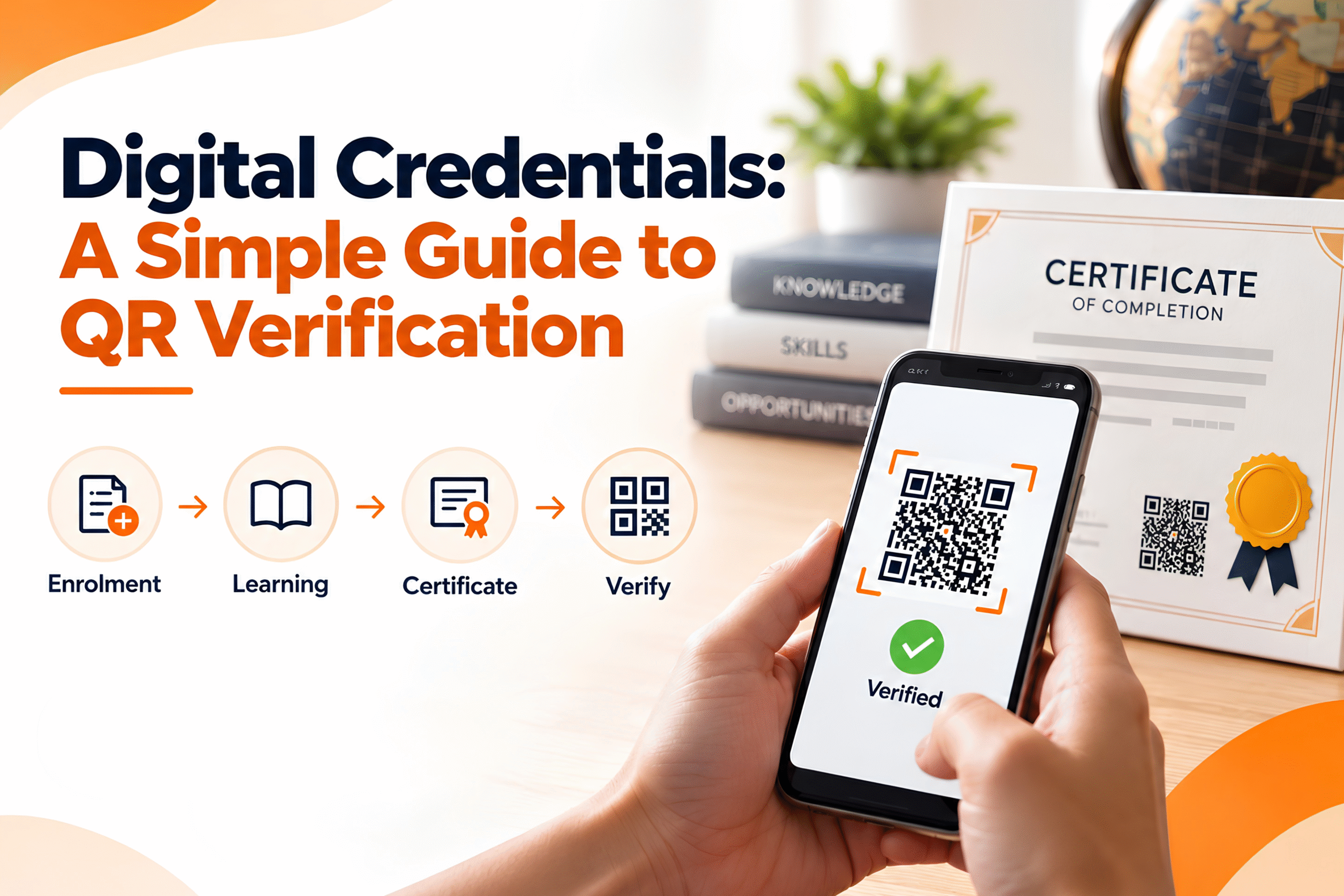
In today’s digital world, education is changing quickly. Digital credentials are becoming an important part of this change. Instead of depending only on printed documents, learners can use digital systems to access, store, and verify their academic and skill achievements.
Digital credentials can make certificate verification easier and more convenient. In addition, details such as a unique serial number and QR code can help connect a certificate with its verification record.
At ODLC, digital verification is part of its technology-supported certification approach. ODLC states that its skill certificates can include a unique serial number and QR code for digital verification, along with online verification and a digital record in the ODLC Skill Database.
So, what are digital credentials? How does QR verification work? And why should learners understand these systems?
Let’s explore these questions step by step.
What Are Digital Credentials?
Digital credentials are digital records that provide information about a learner’s education, skills, training, or certification.
In simple terms, a digital credential helps show what a learner has completed or achieved. Depending on the programme and issuing organisation, a credential may include information such as:
- Learner name
- Programme or course title
- Enrolment or registration details
- Certificate number
- Completion information
- QR code
- Verification details
Therefore, digital credentials can provide a clear connection between a learner and their academic or skill achievement.
Moreover, digital credentials can make it easier for authorised users to check certificate information when verification is required.
Why Are Digital Credentials Important?
Education records are important throughout a learner’s academic and professional journey. However, keeping track of physical documents can sometimes be difficult.
For this reason, digital credentials can offer a more convenient way to manage important certificate information.
For example, digital systems can support:
- Easier access to certificate information
- Faster verification
- Better record management
- Online document checking
- More convenient sharing of credentials
Furthermore, digital credentials can support a more transparent approach to certificate verification.
Instead of relying only on the appearance of a printed certificate, an authorised person can use the available verification process to check the relevant information.
From Enrolment to Digital Credentials
The journey towards digital credentials begins well before a certificate is issued.
First, a learner selects a suitable programme. Next, the learner completes the application process and provides the required documents.
ODLC’s admission form includes academic qualification details and a document checklist. It also states that admission is provisional and subject to document verification and ODLC regulations.
After verification, the learner begins the programme. The learner then progresses through study, assignments, practical activities, assessments, and examinations, depending on the programme.
Finally, after successful completion, the applicable certificate is issued.
This creates a simple journey:
Application → Verification → Enrolment → Learning → Assessment → Completion → Certificate → Digital Verification
As a result, digital credentials become part of a wider learning and certification journey.
What Is QR Verification?
QR verification uses a QR code to provide a quick way to access verification information.
A QR code can be scanned using a compatible smartphone or device. After scanning, the user may be directed to the relevant online verification system, depending on how the issuing organisation has designed its process.
In the case of ODLC skill certificates, the organisation states that certificates feature a unique serial number and QR code for digital verification. ODLC also states that instant online verification is available for these certificates.
Therefore, QR verification can provide a simple connection between a physical or digital certificate and its online verification record.
How Does QR Verification Work?
The process is simple.
Step 1: Receive the Certificate
First, the learner successfully completes the required programme and receives the applicable certificate.
Step 2: Locate the QR Code
Next, the learner or verifier can locate the QR code printed on the certificate, where applicable.
Step 3: Scan the QR Code
Then, the QR code can be scanned using a suitable smartphone or QR scanner.
Step 4: Open the Verification Page
After that, the QR code may take the user to the relevant verification system.
Step 5: Check the Details
Finally, the available certificate information can be checked against the credential being presented.
In this way, digital credentials and QR verification can work together to make credential checking more convenient.
What Information Can Digital Credentials Show?
The exact information can vary by programme and credential.
However, ODLC states that its skill certificates can include details such as:
- Course title
- NSQF level
- Total hours
- Job-role alignment
- Verification information
- Unique serial number
- QR code
As a result, digital credentials can provide useful information beyond the name of a course or qualification.
The information helps create a clearer record of what the learner completed and what credential was issued.
Digital Credentials and Certificate Verification
Certificate verification is important when an organisation needs to confirm an educational or skill credential.
For example, an employer may need to check a certificate during recruitment. Similarly, an institution may need to verify an academic record during an admission process.
In such cases, digital credentials can make the process more structured.
ODLC states that its skill certificate records are maintained in the ODLC Skill Database for employer validation.
Therefore, digital credentials can help connect certification with a digital verification process.
Digital Credentials and DigiLocker
Digital document access is also becoming more important for learners.
ODLC states that it is integrated with DigiLocker and Meri Pehchaan through API Setu, supporting digital certificate access, verification, and single sign-on authentication.
As a result, digital credentials can become easier to access through digital platforms where applicable.
However, learners should always use official platforms and follow the instructions provided by the issuing organisation.
Benefits of Digital Credentials for Learners
Digital credentials can offer several practical benefits.
1. Easy Access
First of all, digital records can make certificate information easier to access when needed.
2. Convenient Verification
Secondly, QR verification can provide a quick way to reach the relevant verification system.
3. Better Record Management
In addition, digital records can help learners keep track of important educational information.
4. Faster Sharing
Furthermore, digital credentials can make it easier to share relevant achievement information when required.
5. Greater Transparency
Most importantly, digital verification can provide an additional way to check credential information.
Therefore, digital credentials can support learners throughout both their academic and professional journeys.
What Should Learners Do With Their Digital Credentials?
Learners should take simple steps to protect and manage their digital credentials.
To begin with, keep your enrolment and certificate details safely. Next, save digital copies of important documents when they are provided.
Also, check that your name, programme details, and other important information are correct.
After receiving your certificate, understand how its verification process works. If the certificate includes a QR code, keep the document clear and readable so that the code can be scanned when needed.
Finally, use the official verification platform when a certificate needs to be checked.
Digital Credentials for Employers and Institutions
Digital credentials are not useful only for learners. They can also support organisations that need to verify qualifications.
For employers, digital verification can provide a convenient way to check available credential information. Similarly, educational institutions can use verification systems when reviewing documents, subject to their own admission and verification policies.
As a result, digital credentials can help create a stronger connection between learning, certification, and verification.
Are Digital Credentials Enough for Every Purpose?
It is important to understand that digital verification does not automatically mean that every organisation will accept a credential for every purpose.
Instead, learners should always check the requirements of the organisation, university, employer, regulator, or government department that will receive the certificate.
ODLC states that it is an autonomous institution and that acceptance of its certifications for government jobs or higher education depends on the policies of the respective department, university, or recruitment body.
Therefore, digital credentials should be viewed as a useful verification and record-keeping tool, while acceptance should always be confirmed with the relevant authority.
The Future of Digital Credentials
The education sector is becoming more connected with digital technology. As a result, digital credentials are likely to play an increasing role in how learning achievements are recorded and verified.
Previously, learners often depended mainly on printed certificates. Today, digital records, QR codes, online verification, and digital document platforms can make credential management more convenient.
Moreover, flexible and online learning is increasing the need for reliable digital records.
ODLC supports flexible learning pathways across secondary, senior secondary, ECCE, skill and vocational education, and other programme areas. Its website also highlights digitally verifiable credentials as part of its learner support approach.
Therefore, digital credentials can become an important part of a modern learner’s education journey.
Final Thoughts
Digital credentials are changing the way learners can manage and verify their educational achievements. From enrolment to certification, each stage can contribute to a clear and structured academic record.
First, learners choose a programme. Then, they complete the required learning and assessments. After successful completion, they receive the applicable certificate. Finally, where digital verification is available, a unique serial number or QR code can help connect the certificate with its verification system.
Most importantly, digital credentials are not simply about technology. They are about making credential information easier to access, check, and manage.
In short, digital credentials bring together learning, certification, accessibility, and verification in one connected process.
Learn. Complete. Certify. Verify.