





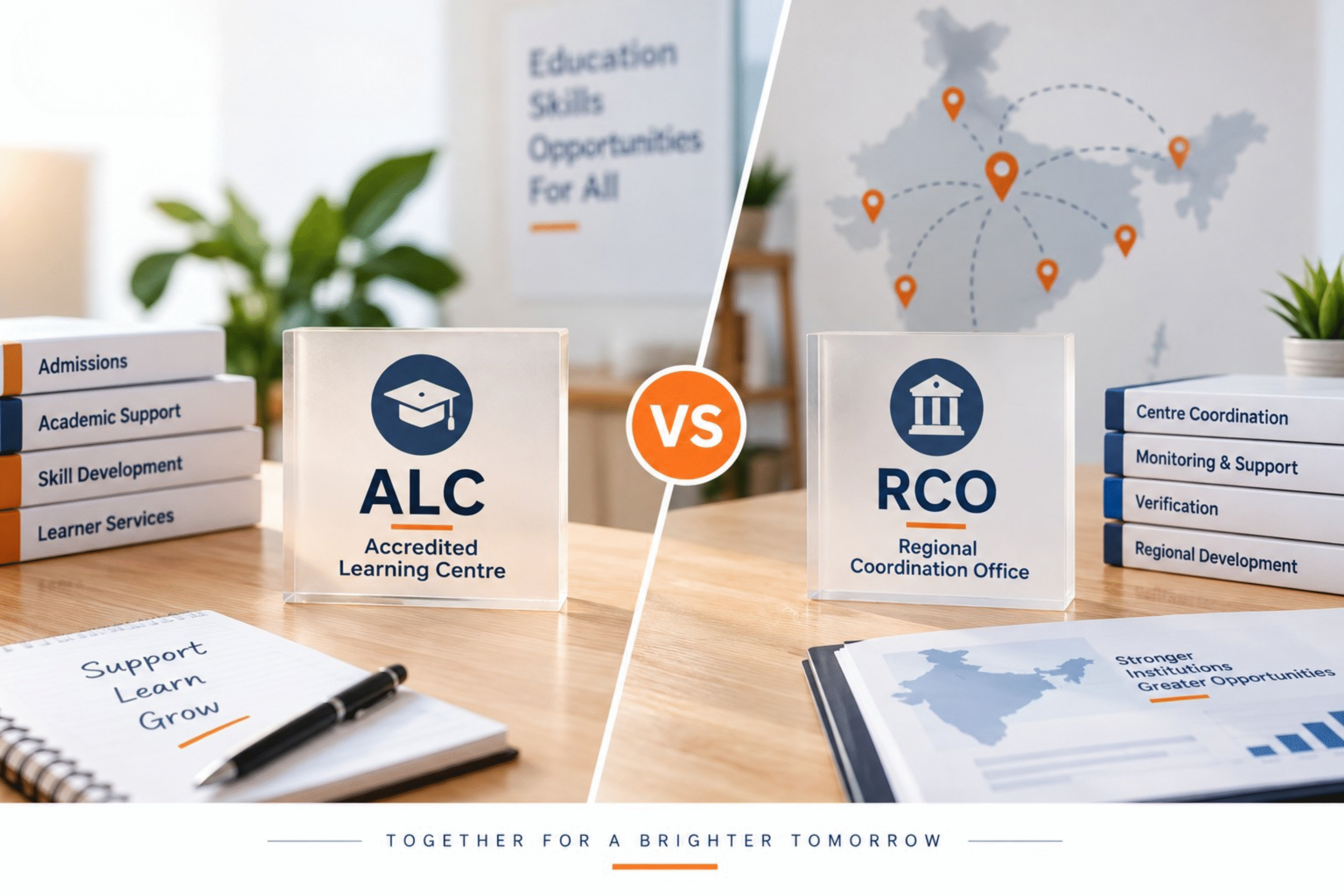
Understanding institutional roles is important when exploring education and skill-development opportunities with ODLC. ALC vs RCO is a common point of confusion because both roles support the ODLC education network, but they serve different purposes.
An Accredited Learning Centre (ALC) mainly works at the institution level. It supports learners, programme delivery, academic activities, and documentation. In contrast, a Regional Coordination Office (RCO) works at the regional level and focuses on coordination, supervision, verification, and oversight.
Therefore, understanding the difference between ALC and RCO can help institutions identify the right role for their needs.
What Is an ALC in ODLC?
ALC stands for Accredited Learning Centre.
According to ODLC, an ALC functions as an academic facilitation unit within its institutional framework. It supports learners and assists with the delivery of approved programmes.
In simple terms, an ALC works closer to the learner.
Its activities can include:
- Learner registration and facilitation
- Academic support
- Programme delivery assistance
- Training and mentoring
- Examination and documentation coordination
- Learner record maintenance
- Assessment and evaluation support
As a result, an ALC can act as a local academic access point for learners.
What Is an RCO in ODLC?
RCO stands for Regional Coordination Office.
An RCO operates at a regional or state level. Its main purpose is to coordinate and oversee academic and institutional activities within its assigned region.
Therefore, an RCO has a broader operational scope than an ALC.
ODLC describes RCO responsibilities that include regional academic oversight, institutional coordination, ALC coordination, verification, and learner facilitation support.
In addition, the ODLC institutional framework states that RCOs can coordinate ALCs and skill or training centres within their approved jurisdiction.
ALC vs RCO: The Basic Difference
The easiest way to understand ALC vs RCO is to look at their level of operation.
| Area | ALC | RCO |
|---|---|---|
| Full form | Accredited Learning Centre | Regional Coordination Office |
| Main level | Institution / centre | Regional / state |
| Main focus | Learner and programme facilitation | Regional coordination and supervision |
| Learner support | Direct | Regional support |
| Programme delivery | Supports delivery | Oversees and coordinates |
| Centre coordination | Operates as a centre | Coordinates ALCs within its scope |
| Verification | Learner-level processes | Centre-level verification and oversight |
| Reporting | Maintains centre records | Submits regional reports as required |
Therefore, while both roles are connected, their responsibilities are not identical.
ALC: Focus on Learner and Programme Facilitation
An ALC has a more direct connection with learners.
For example, learners may approach an ALC for programme information, academic support, registration assistance, or other approved facilitation services.
Furthermore, an ALC may support programme delivery according to ODLC guidelines.
The ODLC framework also places learner verification and eligibility checks at the ALC or skill/training-centre level.
This makes the ALC an important part of the learner-facing side of the institutional structure.
RCO: Focus on Regional Coordination
An RCO has a wider responsibility.
Instead of focusing only on one institution, an RCO can coordinate activities across its approved region.
For example, its responsibilities may include:
- Verifying ALCs and training centres
- Reviewing centre documentation
- Checking infrastructure and trainer qualifications
- Monitoring academic delivery
- Supporting quality assurance
- Coordinating regional activities
- Submitting inspection and compliance reports
As a result, the RCO provides an additional level of regional coordination and oversight.
How ALCs and RCOs Work Together
Although ALC vs RCO highlights their differences, the two roles are also connected.
An ALC supports academic and learner activities at the centre level. The RCO provides regional coordination and oversight.
Therefore, the relationship can be understood as:
ODLC → RCO → ALC → Learner
The exact governance structure can depend on the applicable ODLC framework and approval arrangements.
This structure allows responsibilities to be distributed across different levels while maintaining central academic oversight.
Learner Verification at the ALC Level
Learner verification is an important part of academic integrity.
According to ODLC’s institutional framework, ALCs and skill/training centres are responsible for learner-level verification. This can include checking identity and eligibility documents and confirming learner participation where applicable.
Therefore, the ALC has an important role at the first level of verification.
This process can help maintain accurate learner records and support a structured academic environment.
Centre Verification at the RCO Level
The RCO operates at a different level.
While the ALC focuses on learner-level activities, the RCO can verify and review centres within its jurisdiction.
This may include checking:
- Centre documentation
- Infrastructure
- Trainer qualifications
- Academic delivery
- Learner support
- Compliance requirements
As a result, the RCO provides another layer of institutional oversight.
ALC vs RCO: Who Works With Students?
An ALC generally has a more direct learner-facing role.
Students may interact with an ALC for academic facilitation, programme support, registration-related activities, and documentation assistance.
An RCO, on the other hand, works mainly at the regional coordination level.
However, RCOs can also support learner facilitation when regional coordination is required.
Therefore, the difference is mainly about scope and responsibility, not simply whether a role interacts with learners.
ALC vs RCO: Who Coordinates Institutions?
This is another major difference.
An ALC functions as an approved academic facilitation centre. It manages its activities according to ODLC policies and guidelines.
An RCO has a wider coordination role. ODLC states that RCOs can coordinate ALCs and skill/training centres within their approved region.
Therefore, an RCO can have responsibility for coordinating multiple centres, while an ALC operates at the individual centre level.
ALC vs RCO: Understanding the Approval Structure
ODLC uses verification and approval processes for institutional roles.
The ODLC provides separate application routes for Indian ALC and RCO applicants in its website. It also states that RCO appointments and ALC approvals are subject to ODLC verification and approval.
Therefore, institutions should review the relevant requirements before applying.
Most importantly, an institution should not assume that submitting an application automatically creates an approved institutional role.
Is an ALC the Same as a Franchise?
No.
ODLC’s current institutional information describes the ALC structure as a non-franchise model. It also states that ALCs operate under ODLC academic policies.
Therefore, institutions should use the approved terminology and follow the applicable ODLC guidelines when describing their relationship with ODLC.
Similarly, the ODLC framework describes its NCO–RCO–ALC structure as an institutional governance and oversight structure rather than a commercial franchise or profit-distribution model.
Is an RCO the Same as an ALC?
No.
Although both are part of the ODLC institutional framework, their functions are different.
An ALC focuses mainly on institution-level academic facilitation and learner support.
An RCO focuses on regional coordination, centre oversight, verification, and compliance-related activities.
Therefore, choosing between the two depends on the institution’s intended role, scope, and eligibility under ODLC requirements.
Which Institutions May Consider an ALC Role?
The ODLC describes ALC applications for institutions that can support approved academic and skill-based programmes.
Its published framework includes examples such as:
- Schools and colleges
- Vocational and skill-development institutes
- Training centres
- Other approved institutions aligned with skill-development objectives
Furthermore, ODLC’s ALC information highlights learner facilitation, academic support, programme delivery, and documentation coordination.
Therefore, institutions should review the latest ODLC requirements before deciding whether an ALC pathway fits their objectives.
Who May Consider an RCO Role?
An RCO has a wider regional scope.
Therefore, institutions considering an RCO role should understand that the position involves more than operating a local learning centre.
The ODLC framework describes RCO responsibilities such as centre verification, regional academic supervision, monitoring, inspection, reporting, and coordination.
As a result, the RCO role is suited to a broader institutional coordination function, subject to ODLC approval and applicable requirements.
Why Understanding ALC vs RCO Matters
Understanding ALC vs RCO can help institutions avoid confusion when exploring ODLC collaboration opportunities.
It can help answer important questions such as:
- What type of institutional role do we need?
- Will we work mainly with learners?
- Do we need a regional coordination function?
- What responsibilities will the institution have?
- What level of verification is involved?
- What approval process applies?
Therefore, institutions should first understand the role and then review the relevant ODLC application and approval requirements.
Important Note for Institutions
ODLC’s institutional roles operate under its stated governance, verification, and approval framework. Therefore, institutions should always refer to the latest official ODLC information before making decisions about an ALC or RCO application.
Requirements, responsibilities, fees, approval conditions, and operational policies may change over time.
Furthermore, institutions should avoid making claims about government recognition, equivalency, affiliation, or other status beyond what ODLC officially permits.
Final Thoughts
Overall, ALC vs RCO is mainly a difference in institutional scope and responsibility.
An ALC works at the centre level. It focuses on learner facilitation, academic support, programme delivery, assessments, and documentation.
An RCO works at the regional level. It focuses on coordination, centre verification, academic oversight, monitoring, and compliance support.
Therefore, both roles have a place within the ODLC institutional framework, but they are designed for different responsibilities.
Most importantly, institutions should understand their intended role, review the applicable ODLC requirements, and follow the official approval process before presenting themselves as an ALC or RCO.
By clearly understanding ALC vs RCO, institutions can make better-informed decisions about their potential role within the ODLC academic and skill-development network.